Use the Gain and Lift charts to assess the performance of your
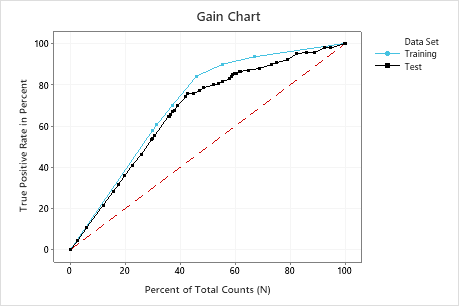
classification model. The Gain chart plots the total positive rate in percent
versus the percent of total counts. So, for example, these charts can show that
80% of the events are in 20% of the data. Thus, by focusing on 20% of the data,
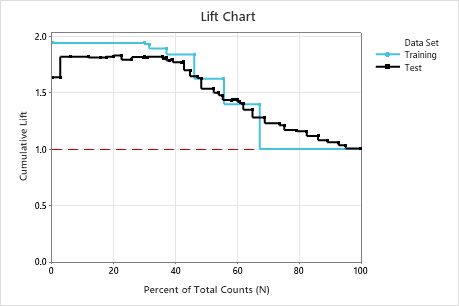
we can be efficient with our resources. The Lift chart plots the cumulative
lift (or non-cumulative lift) versus the percent of total counts.
Interpretation of Gain chart
When the analysis uses a validation method, the chart has a line for the training data and a
line for the validation results. The training and validation lines represent the expected
response using the predictive model. The training data set fits the model and the validation
results evaluate the model. The dotted reference line represents a line with slope = 1,
which is the expected random response without the model. Gains larger than 1 indicate that
the results from the predictive model are better than random.
In this example, the gain chart shows a sharp increase above the reference line,
then a flattening. In this case, approximately 40% of the data account for approximately
70% of the true positives.
Interpretation of Lift chart
When the analysis uses a validation method, the chart has a line for the training data and a
line for the validation results. The training and validation lines represent the expected
response using the predictive model. The training data set fits the model and the validation
results evaluate the model. Lift is the ratio of the gain percentage relative to the
expected random result. The dotted reference line represents a cumulative lift of 1, which
means that there is no gain compared with random.
In this example, the lift chart shows an increase above the reference line that
gradually drops off.