In This Topic
Plotted points
Center line
The center line represents the process mean, μ. If you do not specify a historical value for the process mean, Minitab uses the mean of the observations.
Control limits
If you do not specify a historical value for the process standard deviation, σ, then Minitab estimates σ from your data using the specified method.
Lower control limit (LCL)

Upper control limit (UCL)

Notation
| Term | Description |
|---|---|
| μ | process mean |
| k | parameter for Test 1. The default is 3. |
Extended control limits: Between/within approach
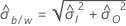
Use the between/within approach to calculate extended control limits from within-subgroup and between-subgroup standard variation.
Subgroup size = 1



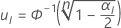
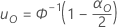
Where uI and uO are quantiles of the standardized normal distribution.
Notation for between/within approach
| Term | Description |
|---|---|
| μ̂ | estimate of process mean |
| σ̂I | estimate of within-subgroup standard deviation |
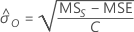
| σ̂O | estimate of between-subgroup standard deviation. If there is only 1 subgroup, then σ̂O = 0. |
| n | length of the moving range when the subgroup size is 1 |
| αI | false alarm probability for within-subgroup standard deviation |
| Φ-1 | the inverse cumulative distribution function of the standard normal distribution |
| αO | false alarm probability for between-subgroup standard deviation |
| MSS | the mean square associated with subgroup-to-subgroup variation |
| MSE | mean squared error. The within-subgroup mean square subtracted from the subgroup mean square before estimating the between-subgroup standard deviation component. |
| C | coefficient for the expected mean square for subgroups as a random
factor. For the calculations of expected mean squares and for information on unbalanced or more complex models, see Montgomery1 and Neter2.
|
Extended control limits: Min/max mean approach
Use the min/max mean approach to calculate extended control limits from the minimum and maximum group means.
Subgroup size = 1



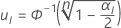
Where uI is the quantile of the standardized normal distribution.
Notation for min/max approach
| Term | Description |
|---|---|
| μ̂ | estimate of process mean |
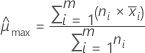
| μ̂max | estimate of the maximum process mean. Using the length of the moving range as the subgroup size, this estimate is the weighted average of the m largest subgroup means. If the analysis specifies to use more subgroups than are in the data, m is the number of subgroups. |
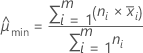
| μ̂min | estimate of the minimum process mean. Using the length of the moving range as the subgroup size, this estimate is the weighted average of the m smallest subgroup means. If the analysis specifies to use more subgroups than are in the data, m is the number of subgroups. |
| m | number of subgroup means to average |
| σ̂I | estimate of within-subgroup standard deviation |
| n | length of the moving range when the subgroup size is 1 |
| Φ-1 | the inverse cumulative distribution function of the standard normal distribution |
| αI | false alarm probability for within-subgroup standard deviation |
Standard deviation for extended limits
When extended limits are selected, use the following standard deviation for stored variation values and additional sigma limits.